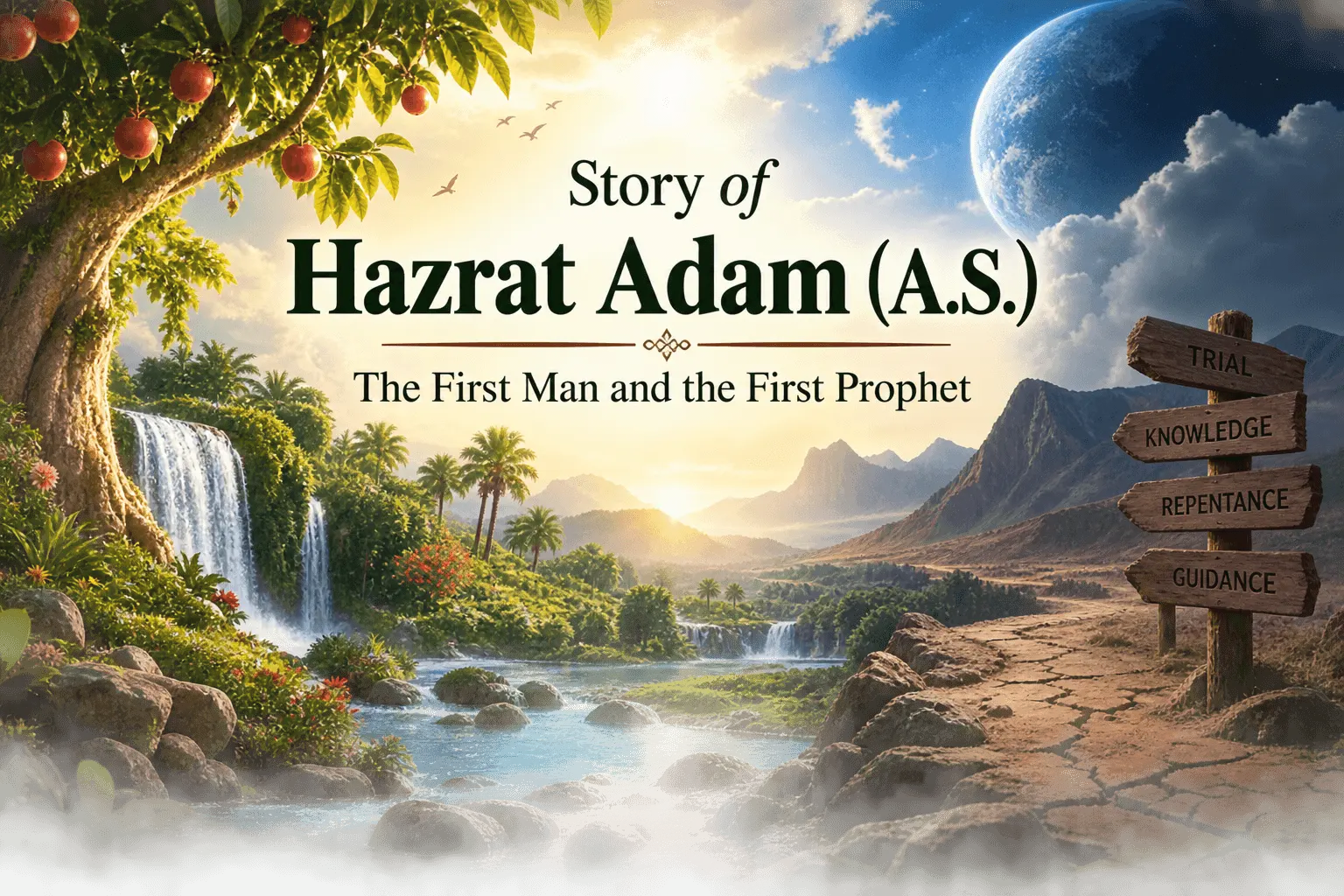
Story of Hazrat Adam (A.S.) – The First Man and the First Prophet
Before Adam: Allah's Announcement to the Angels
The story doesn't actually open with Adam's creation. It opens earlier, with an announcement. Allah tells the angels He's about to place a successive authority on earth — a khalifah (Surah Al-Baqarah 2:30). That word carries more weight than a simple translation like "ruler" suggests. It implies someone trusted with responsibility, someone who inherits the earth and answers for how it's treated.
The angels ask a question in response, and it doesn't come from defiance — more from genuine curiosity. Why place a being on earth who might cause corruption and bloodshed? They seem to already sense something about the nature of free will and its risks. Allah doesn't brush the question aside. He simply replies, "I know what you do not know." Short answer. But it sets the tone for everything that follows — there are dimensions to this creation that even angels, for all their devotion, can't fully see.
Creation From Clay
Adam was formed from clay, shaped directly, described in the Qur'an in terms that leave little room for metaphor. For a while, he remained lifeless — a figure waiting. Then came the turning point: Allah breathed His own spirit into that shape, and suddenly there was a being who could think, speak, and choose for himself.
Why This Detail Matters
Unlike other parts of creation, humanity begins with something breathed in directly from Allah, not just formed. That's part of why human dignity gets taken so seriously in Islamic thought, no matter how far someone might later stray from it.
Knowledge as a Distinguishing Gift
Before the story moves any further, something unusual happens. Allah teaches Adam the names of all things — a depth of knowledge the angels themselves never had. When Allah turns around and asks the angels to name these same things, they can't. Their response is humble: "Glory be to You, we have no knowledge except what You have taught us. Indeed, it is You who is the Knowing, the Wise" (Surah Al-Baqarah 2:32).
Then it's Adam's turn, and he answers correctly. That single exchange says a lot. Human beings, right from the start, were given a capacity for learning that set them apart — even from angels who'd spent their entire existence in worship. Knowledge wasn't something Adam had to earn through struggle. It came built into his design.
The Prostration and Iblis's Refusal
With that established, Allah commands the angels to bow before Adam. Not worship — that belongs to Allah alone — but a gesture of honor, recognizing Adam's new position as the one entrusted with knowledge and with khilafah. Every angel obeys. One doesn't.
Iblis refuses, and his reasoning gives away exactly what went wrong inside him: he was made from fire, fire is better than clay, so why should he bow? Small statement, enormous consequences. Arrogance dressed up as logic, basically. Allah doesn't accept the excuse, and Iblis is stripped of the rank he once held.
Iblis's Request for Respite
He doesn't vanish, though. He asks Allah for time — respite until the Day of Judgment — so he can try to mislead Adam's descendants. Allah grants it, with one condition made clear: Iblis will have no real power over anyone who stays sincere in their faith. That exchange basically sets up the entire human struggle that follows.
Life in Paradise and the Forbidden Tree
Adam is placed in Paradise, given nearly everything, and Hawa (Eve) is created so he wouldn't be alone. Together they're free to enjoy what's around them, with one boundary — stay away from a specific tree. Not a difficult test. Not unreasonable either. Just clear.
Iblis, true to his promise, doesn't wait long. He approaches with persuasion rather than force, suggesting the tree holds the secret to eternal life, to a kingdom that never fades. Notice how the temptation is framed — not rebellion for its own sake, but something that looks like a genuine benefit. Eventually, both Adam and Hawa eat from it. Not defiance against Allah. Deception, plain and simple — they believed it would actually help them.
Repentance and Descent to Earth
What happens right after might be the most important part of the whole story. The instant Adam and Hawa realize what they've done, there's no justifying it, no pointing fingers at each other or at Iblis. They turn straight to Allah. Their words are preserved in the Qur'an, and Muslims still recite them generations later: "Our Lord, we have wronged ourselves, and if You do not forgive us and have mercy upon us, we will surely be among the losers" (Surah Al-A'raf 7:23).
That response is what separates Adam's mistake from Iblis's. Iblis met his error with arrogance and excuses. Adam met his with humility and an immediate return to Allah. Allah accepts the repentance — but the consequence of the act still holds, and Adam and Hawa are sent down to earth. Not abandonment. Not mercy withheld. Just the beginning of a new chapter, one where humanity would live, be tested, choose, and always have the door open to return to Allah.
Adam as the First Prophet
Once on earth, Adam isn't left to figure it out on his own. Allah makes him a prophet, sending revelation to guide his own life and pass on to his children — how to worship, how to live, how to tell right from wrong in a world that would only get more complicated. He becomes the father of humanity in the fullest sense — not just through lineage, but through carrying the very first responsibility of pointing people back toward Allah.
What This Story Actually Teaches
This isn't a tale about a permanent fall that defines humanity forever, and it's not meant to hang guilt over every generation after. It's a story about what comes right after a mistake — that's really where the lesson sits. Adam didn't argue with Allah. Didn't blame Hawa. Didn't even blame Iblis, though Iblis clearly played his part. He owned the mistake immediately and turned back without hesitation.
That's the model Islam holds up as ideal — sincere repentance over excuses, humility over arrogance, and the reminder that failing a test isn't the end of anyone's story. How you respond to the failure is what actually defines you.
A few other threads run through this too. Knowledge shows up as a gift from the very beginning, meant to be handled with responsibility, not pride. Arrogance — Iblis's refusal is the clearest example — turns out to be far more dangerous than an honest mistake made out of weakness. And running underneath all of it is one reassurance: Allah's mercy stays open to anyone who comes back sincerely, regardless of what happened before.
Conclusion
Hazrat Adam (A.S.) began as a shape of clay and became the first human being trusted with knowledge, free will, and prophethood. Paradise, the mistake, the repentance that followed — all of it set a pattern that would repeat again and again through human history. Every person gets tested. Every person falls short somewhere. What actually matters, in the end, is the sincerity with which they turn back to Allah afterward. In a lot of ways, Adam's story isn't just where humanity begins. It's the first lesson every person after him would eventually need to learn.